

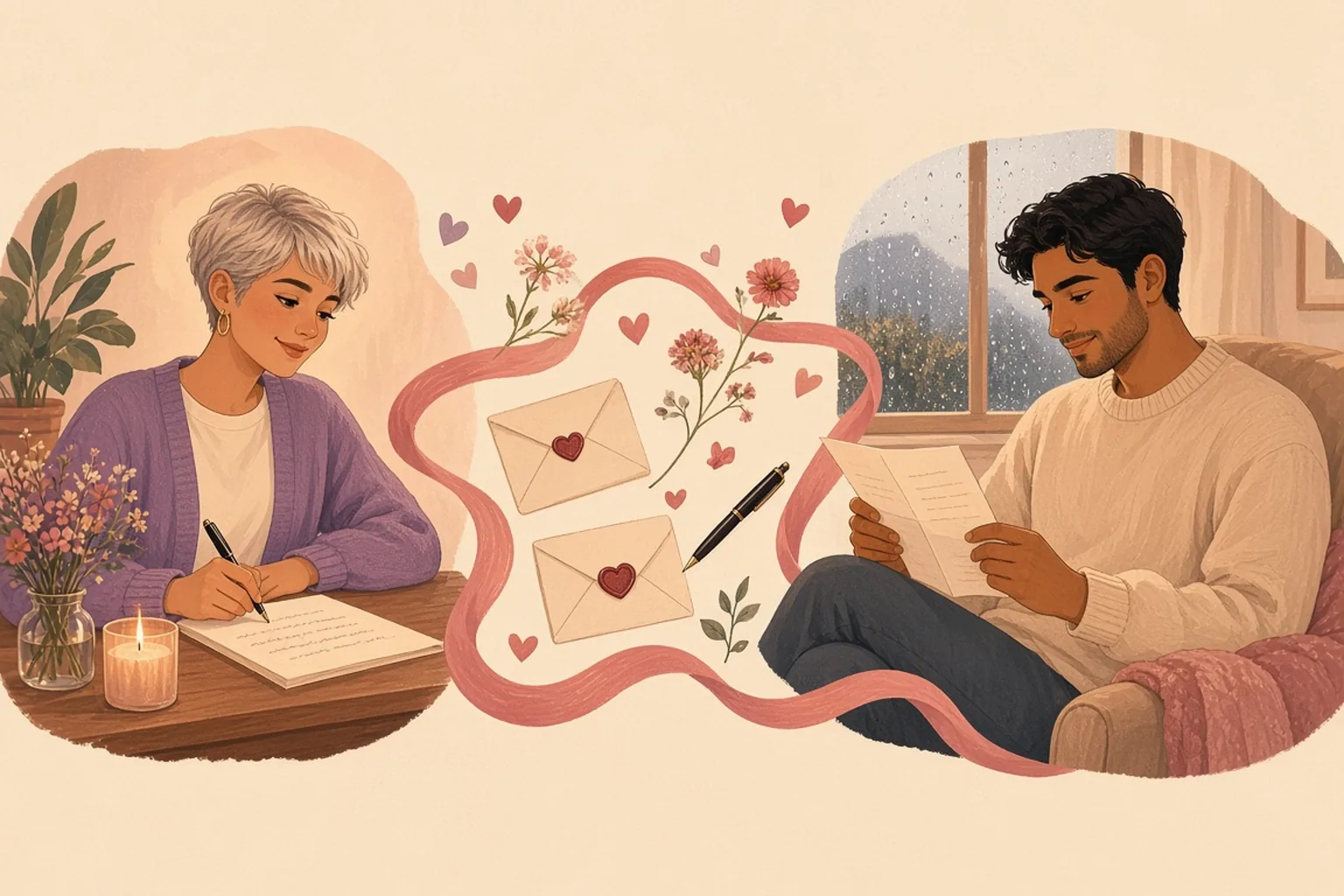
A love letter is the one thing in a long-distance relationship that gets better with time. Messages scroll away; a letter gets reread on bad days, kept in a drawer and found again years later. You do not need to be a good writer to write one. You need a structure, one or two specific memories and the willingness to say plainly how you feel. This guide gives you a five-part structure, prompts for each part, three short example letters and ideas for ‘open when’ letters your partner can save for the right moment.
A simple structure for a long-distance love letter
Most good love letters, whatever their length, follow roughly the same shape. Use it as a skeleton and write a few sentences for each part.
1. Open with where you are
2–3 sentences
Tell them where you are sitting and what is around you. ‘I am writing this at the kitchen table with the radiator clanking and your mug next to me.’ It puts them in the room with you.
2. Share one specific memory
A short paragraph
Choose one moment and describe it in detail: what you saw, heard and felt. The smaller and more specific, the better. ‘The night we got lost looking for that restaurant and ended up eating chips on a wall.’
3. Say what you love about them
3–5 sentences
Name qualities and give examples. ‘I love how patient you are, like when you explained the same card game to my nephew six times.’
4. Be honest about the distance
2–4 sentences
Acknowledge what is hard without making it the whole letter. ‘Some evenings I miss you so much I reread our messages from the start.’
5. Look forward
2–3 sentences
End with something concrete you are looking forward to: the next visit, a plan, an ordinary day you want to share.
Prompts when you do not know what to write
If you are staring at a blank page, answer one of these honestly and build from there.
- The first time I realised I was falling for you was…
- A small thing you do that nobody else notices is…
- When I miss you most, I…
- Something I have never told you is…
- The first thing I want to do when I see you is…
- Since we met, I have changed in this way…
- A place I want to take you, and why…
- An ordinary day with you would look like…
Three short example letters
These are written to be adapted. Replace every detail in brackets with your own, and cut anything that does not sound like you.
A letter for an ordinary week
About 150 words
‘Dear [name], I am writing this on the train, which is now officially the place I miss you most, because it is where I used to call you. Do you remember [specific memory]? I still laugh about [detail]. I love how you [quality, with example]. This week has been long, and some nights the distance feels bigger than the map says. But then you send me [small thing] and it shrinks again. [Number] days until I see you. I have already decided we are going to [plan]. All my love, [your name].’
A letter for a hard time
About 120 words
‘[Name], I know things are heavy at the moment. I cannot fix them from here, and I will not pretend I can. But I want you to have something you can hold. You are [quality]. I saw it when [memory]. You do not have to be strong in this letter; you can just read it and know that somebody far away is thinking about you on purpose. Call me whenever you want, even if it is the middle of my night. I love you. [Your name].’
A letter for after a visit
About 100 words
‘[Name], the flat is too quiet. Your [object] is still on the shelf and I am not moving it. Thank you for [specific moment from the visit]. I keep replaying it. Goodbyes do not get easier, but I am starting to see them as the beginning of a countdown instead of the end of something. See you in [time]. [Your name].’
Open-when letters: letters for the right moment
Open-when letters are a set of sealed envelopes, each labelled with a moment: ‘open when you miss me’, ‘open when you cannot sleep’, ‘open when you have good news’. They work brilliantly across time zones, because your partner opens them exactly when they need them, without waiting for you to wake up.
Keep each one short, a few paragraphs, and match the content to the label. A ‘can’t sleep’ letter might include a story; a ‘bad day’ letter might include a list of reasons they are wonderful and a small treat to tuck inside.
- Open when you miss me
- Open when you have had a bad day
- Open when you cannot sleep
- Open when you need a laugh
- Open when we have argued
- Open the night before I visit
- Open when you have achieved something big
Love letter ideas for specific occasions
The five-part structure works for any letter, but the focus changes with the occasion.
Your first love letter
Keep it light
Focus on the beginning: the first thing you noticed, the moment you knew you liked them, and why you are excited about what comes next. It does not have to be a declaration.
An anniversary letter
Look back, then forward
Choose one memory from each season of the year, then finish with what you hope the next year holds.
A birthday letter
All about them
Write about who they are, not about the relationship: what you admire, how they have grown, what you wish for them this year.
A ‘see you soon’ letter
Before a visit
List the small things you are looking forward to doing together, from the big plans to the cup of tea on the first morning.
A letter after a hard period
Gratitude
Thank them for specific things they did while things were difficult. Recognition is one of the most powerful things a letter can carry.
Make the letter feel special
A physical letter is an object as well as words. A few small touches make it something your partner will keep: good paper, your best handwriting, a date at the top, a small doodle in the margin. Some couples add a pressed flower, a photo, a ticket from a past date or a few drops of a familiar scent, though check that anything you add is allowed in the post to their country.
If you are sending a digital letter, write it in a document rather than a chat message, add a photo and send it at a time when they can read it slowly.
Sending your letter: post, scan or both
Handwritten letters feel special because they take effort, but international post can take weeks. If timing matters, for an anniversary, birthday or holiday, post it well ahead and consider sending a photo or scan on the day so they can read it on time, then keep the paper version when it arrives.
For the holiday season, carriers publish their own deadlines; our long-distance holidays guide lists the 2026 USPS and Royal Mail recommendations.
Common love letter mistakes
Writing about the relationship in general instead of moments in particular. ‘You mean everything to me’ is lovely, but ‘you stayed up until 3am helping me with my application’ is unforgettable.
Using it to resolve an argument. A love letter is not the place to win a point.
Copying quotes or poems without adding yourself. If you include a line from someone else, say why it made you think of them.
Q & A
A few questions you might have
How do you write a long distance love letter?
Start with where you are as you write, share one specific memory, say what you love about your partner with examples, be honest about the distance and end with something you are looking forward to. Specific details matter more than beautiful wording.
How long should a love letter be?
There is no rule. A single page is plenty for most letters. A short letter full of specific memories is more meaningful than a long one full of general statements.
What are open when letters?
Open-when letters are a set of sealed letters, each labelled with a moment such as ‘open when you miss me’ or ‘open when you cannot sleep’. Your partner opens each one when they need it.
Should I send a handwritten letter or a digital one?
Both work. Handwritten letters can be kept and reread, but post can be slow, especially internationally. For time-sensitive occasions, many couples post a letter early and send a photo of it on the day.
Found an idea for the two of you?
Send it to your person and choose something to try together.